Stokrio for fashion & apparel
Inventory planning built for sizes, seasons and drops
Every style becomes a dozen SKUs, buys happen months before the season, and best sellers run out in the middle sizes first. Stokrio plans each size on its own sales and tells you what to re-order while there is still time.
The problem
Why fashion & apparel inventory is hard
Style-level plans hide size problems
A style that looks healthy in total can be sold out in M and overstocked in XS. Planning has to happen per size and colour, not per style.
Long production lead times
Factories need orders months ahead, so the buy is made on a forecast — and a wrong forecast is locked in until the next season.
Seasonality and drops
Demand ramps for a season or a campaign and then falls away. Averages over the last 30 days miss the ramp on the way up and over-order on the way down.
Cash tied up in slow styles
Markdowns come late because nobody sees which styles stopped selling until the season review.
How Stokrio fits
Built for the way you plan
Demand forecasting
Forecasts per size and colour
Each Shopify variant is planned as its own SKU, with seasonality detected per product and stockout days excluded so sold-out sizes don't look unpopular.
Learn moreReplenishment & reorder planning
Mid-season re-orders
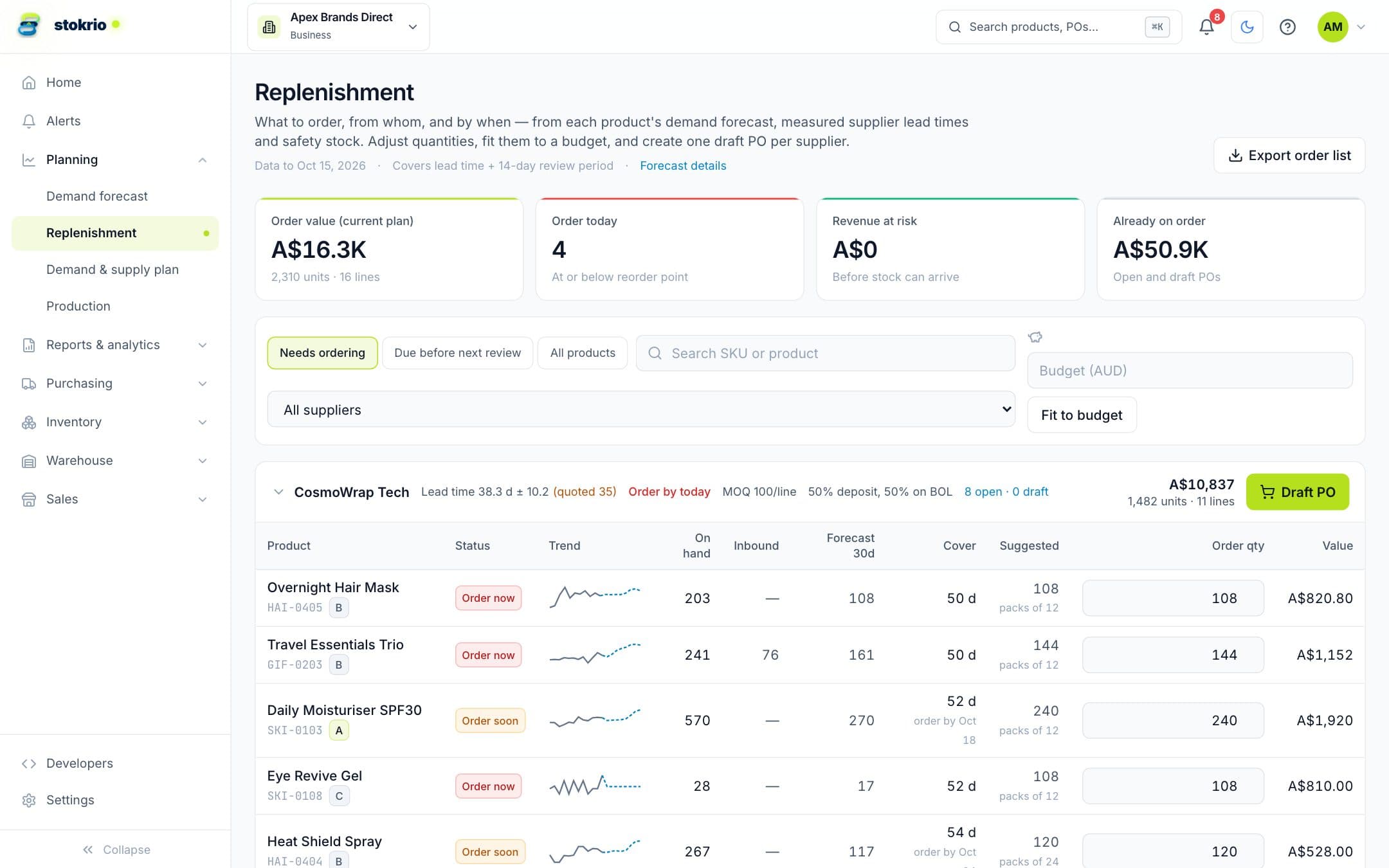
Order-by dates from each supplier's measured lead time, rounded to case packs and minimums, with revenue at risk to decide what goes first.
Learn moreDemand & supply plan
Season plans with overrides
Set monthly targets for a launch or campaign, or apply last year plus growth, and replenishment follows the plan.
Learn moreInventory reports & analytics
Sell-through and aging
Sell-through, inventory aging and excess stock reports show what to mark down before it becomes dead stock.
Learn morePurchase orders & receiving
POs that arrive in parts
Factories ship in instalments — receive partial deliveries and keep the remainder on order in every forecast.
Learn moreA typical rhythm
What planning looks like week to week
- 01
Before the season
Build the monthly plan per style from last year plus growth, then let the supply plan show what to order and when.
- 02
During the season
Check alerts each morning for sizes about to sell out and sales spikes worth re-ordering into.
- 03
After the season
Use sell-through and aging reports to decide markdowns and what not to re-buy.
Questions
Does Stokrio forecast each size separately?
How are new styles with no history handled?
Can I plan a collection drop?
Further reading
Forecasting
Seasonal demand forecasting: Holt-Winters, seasonal profiles and the Q4 ramp
How to forecast seasonal products, when to use Holt-Winters versus a seasonal profile, and how to time Q4 orders when lead times are long — with a worked example.
Forecasting
Forecasting new products without sales history: analogues, category rates and early reads
How to forecast a product launch with no history: borrow from similar products, use category rates, read the first weeks of sales properly, and size the first order around the risk.
Reports
Dead stock and excess inventory: find it, age it, clear it
How to define and measure dead and excess stock, use aging buckets, cancel surplus purchase orders, and clear slow stock without training customers to wait for discounts.
See Stokrio with your own data
Create a workspace in minutes. Connect Shopify or start with the API.